mirror of
https://github.com/didi/KnowStreaming.git
synced 2026-01-18 06:24:26 +08:00

7.1 KiB
7.1 KiB
我们有分析过TopicCommand之创建Topic源码解析; 因为篇幅太长所以 关于分区分配的问题单独开一篇文章写;
源码分析
创建Topic的源码入口 AdminManager.createTopics()
以下只列出了分区分配相关代码其他省略
def createTopics(timeout: Int,
                   validateOnly: Boolean,
                   toCreate: Map[String, CreatableTopic],
                   includeConfigsAndMetatadata: Map[String, CreatableTopicResult],
                   responseCallback: Map[String, ApiError] => Unit): Unit = {

   // 1. map over topics creating assignment and calling zookeeper
    val brokers = metadataCache.getAliveBrokers.map { b => kafka.admin.BrokerMetadata(b.id, b.rack) }

    val metadata = toCreate.values.map(topic =>
      try {
        val assignments = if (topic.assignments().isEmpty) {
          AdminUtils.assignReplicasToBrokers(
            brokers, resolvedNumPartitions, resolvedReplicationFactor)
        } else {
          val assignments = new mutable.HashMap[Int, Seq[Int]]
          // Note: we don't check that replicaAssignment contains unknown brokers - unlike in add-partitions case,
          // this follows the existing logic in TopicCommand
          topic.assignments.asScala.foreach {
            case assignment => assignments(assignment.partitionIndex()) =
              assignment.brokerIds().asScala.map(a => a: Int)
          }
          assignments
        }
        trace(s"Assignments for topic $topic are $assignments ")

  }
- 以上有两种方式,一种是我们没有指定分区分配的情况也就是没有使用参数
--replica-assignment;一种是自己指定了分区分配
1. 自己指定了分区分配规则
从源码中得知, 会把我们指定的规则进行了包装,注意它并没有去检查你指定的Broker是否存在;
2. 自动分配 AdminUtils.assignReplicasToBrokers
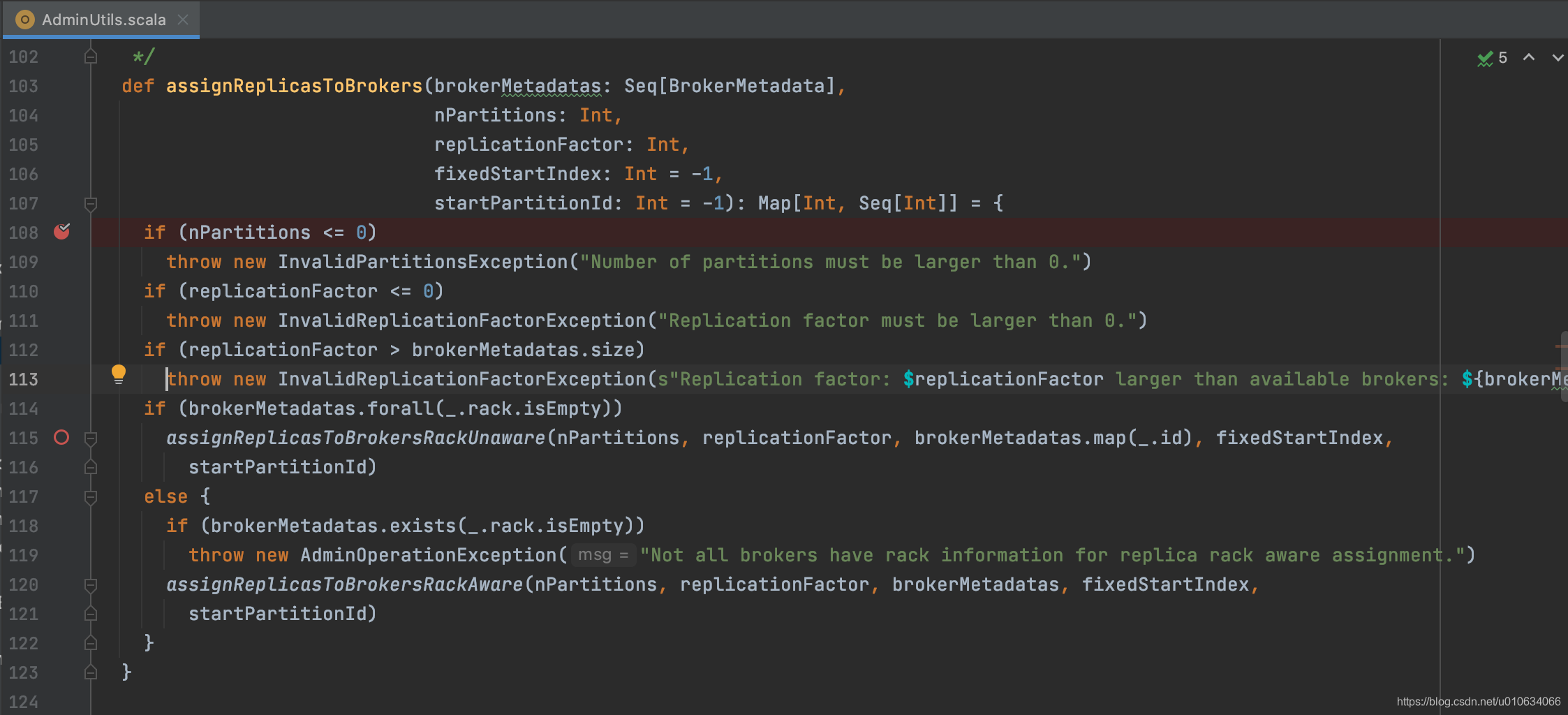
- 参数检查: 分区数>0; 副本数>0; 副本数<=Broker数 (如果自己未定义会直接使用Broker中个配置)
- 根据是否有 机架信息来进行不同方式的分配;
- 要么整个集群都有机架信息,要么整个集群都没有机架信息; 否则抛出异常
无机架方式分配
AdminUtils.assignReplicasToBrokersRackUnaware
/**
   * 副本分配时,有三个原则:
   * 1. 将副本平均分布在所有的 Broker 上;
   * 2. partition 的多个副本应该分配在不同的 Broker 上;
   * 3. 如果所有的 Broker 有机架信息的话, partition 的副本应该分配到不同的机架上。
   *
   * 为实现上面的目标,在没有机架感知的情况下,应该按照下面两个原则分配 replica:
   * 1. 从 broker.list 随机选择一个 Broker,使用 round-robin 算法分配每个 partition 的第一个副本;
   * 2. 对于这个 partition 的其他副本,逐渐增加 Broker.id 来选择 replica 的分配。
   */

  private def assignReplicasToBrokersRackUnaware(nPartitions: Int,
                                                 replicationFactor: Int,
                                                 brokerList: Seq[Int],
                                                 fixedStartIndex: Int,
                                                 startPartitionId: Int): Map[Int, Seq[Int]] = {
    val ret = mutable.Map[Int, Seq[Int]]()
    // 这里是上一层传递过了的所有 存活的Broker列表的ID
    val brokerArray = brokerList.toArray
    //默认随机选一个index开始
    val startIndex = if (fixedStartIndex >= 0) fixedStartIndex else rand.nextInt(brokerArray.length)
    //默认从0这个分区号开始
    var currentPartitionId = math.max(0, startPartitionId)
    var nextReplicaShift = if (fixedStartIndex >= 0) fixedStartIndex else rand.nextInt(brokerArray.length)
    for (_ <- 0 until nPartitions) {
      if (currentPartitionId > 0 && (currentPartitionId % brokerArray.length == 0))
        nextReplicaShift += 1
      val firstReplicaIndex = (currentPartitionId + startIndex) % brokerArray.length
      val replicaBuffer = mutable.ArrayBuffer(brokerArray(firstReplicaIndex))
      for (j <- 0 until replicationFactor - 1)
        replicaBuffer += brokerArray(replicaIndex(firstReplicaIndex, nextReplicaShift, j, brokerArray.length))
      ret.put(currentPartitionId, replicaBuffer)
      currentPartitionId += 1
    }
    ret
  }
有机架方式分配
 private def assignReplicasToBrokersRackAware(nPartitions: Int,
                                               replicationFactor: Int,
                                               brokerMetadatas: Seq[BrokerMetadata],
                                               fixedStartIndex: Int,
                                               startPartitionId: Int): Map[Int, Seq[Int]] = {
    val brokerRackMap = brokerMetadatas.collect { case BrokerMetadata(id, Some(rack)) =>
      id -> rack
    }.toMap
    val numRacks = brokerRackMap.values.toSet.size
    val arrangedBrokerList = getRackAlternatedBrokerList(brokerRackMap)
    val numBrokers = arrangedBrokerList.size
    val ret = mutable.Map[Int, Seq[Int]]()
    val startIndex = if (fixedStartIndex >= 0) fixedStartIndex else rand.nextInt(arrangedBrokerList.size)
    var currentPartitionId = math.max(0, startPartitionId)
    var nextReplicaShift = if (fixedStartIndex >= 0) fixedStartIndex else rand.nextInt(arrangedBrokerList.size)
    for (_ <- 0 until nPartitions) {
      if (currentPartitionId > 0 && (currentPartitionId % arrangedBrokerList.size == 0))
        nextReplicaShift += 1
      val firstReplicaIndex = (currentPartitionId + startIndex) % arrangedBrokerList.size
      val leader = arrangedBrokerList(firstReplicaIndex)
      val replicaBuffer = mutable.ArrayBuffer(leader)
      val racksWithReplicas = mutable.Set(brokerRackMap(leader))
      val brokersWithReplicas = mutable.Set(leader)
      var k = 0
      for (_ <- 0 until replicationFactor - 1) {
        var done = false
        while (!done) {
          val broker = arrangedBrokerList(replicaIndex(firstReplicaIndex, nextReplicaShift * numRacks, k, arrangedBrokerList.size))
          val rack = brokerRackMap(broker)
          // Skip this broker if
          // 1. there is already a broker in the same rack that has assigned a replica AND there is one or more racks
          //    that do not have any replica, or
          // 2. the broker has already assigned a replica AND there is one or more brokers that do not have replica assigned
          if ((!racksWithReplicas.contains(rack) || racksWithReplicas.size == numRacks)
              && (!brokersWithReplicas.contains(broker) || brokersWithReplicas.size == numBrokers)) {
            replicaBuffer += broker
            racksWithReplicas += rack
            brokersWithReplicas += broker
            done = true
          }
          k += 1
        }
      }
      ret.put(currentPartitionId, replicaBuffer)
      currentPartitionId += 1
    }
    ret
  }